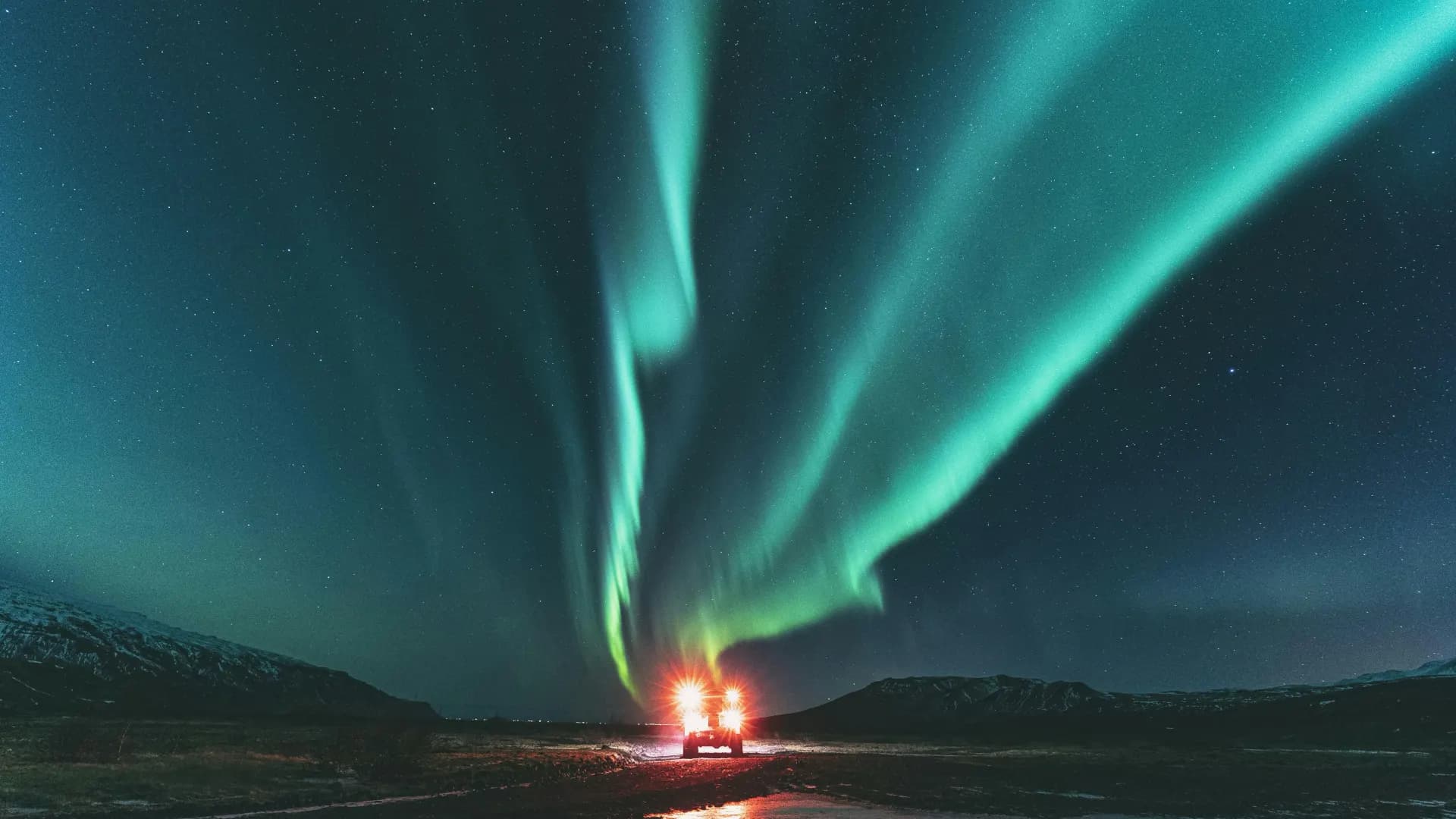
Abisko is a tiny settlement in the Swedish Lapland mountains, home to just a handful of permanent residents and surrounded entirely by Abisko National Park. Despite its remoteness — accessible only by train or a winding mountain road — it draws aurora seekers from around the world who have learned its secret: a remarkably persistent microclimate that keeps the sky clear even when the surrounding region is blanketed in cloud. The Aurora Sky Station, reached by gondola to the shoulder of Mount Nuolja at 900 m, elevates visitors literally above the low cloud layer and into crystalline viewing conditions. Combined with zero light pollution and a position deep inside the auroral oval, Abisko delivers aurora experiences that photographers describe as career-defining.
Abisko sits at 68.3°N and geomagnetic latitude 65.5°N, directly inside the auroral oval's most active zone. Even during KP 0–1 geomagnetic conditions, electrons streaming along magnetic field lines converge over this latitude and produce luminous collisions with atmospheric oxygen and nitrogen. The visible result is typically a green arc at 100–150 km altitude that may evolve into dancing curtains, coronas, and pulsating sheets as activity increases. Abisko's position slightly west of Kiruna means it sees more of the magnetic midnight sector — the period of maximum auroral activity — between roughly 10 PM and 2 AM local time.
The aurora season runs September through March, but Abisko's statistics are extraordinary: the Aurora Sky Station claims over 300 aurora nights per season are detectable from the mountain. September is magnificent — clear autumn air, the first displays of the season over orange-and-red tundra, and a landscape not yet locked under deep snow. November through January brings polar night and the darkest conditions. February is widely considered the optimal month: darkness is still profound, but the snow is at its most pristine and mid-winter cold begins moderating. Late March can still produce aurora on clear nights as the season tapers.
The Aurora Sky Station gondola runs on specific nights during the season — book well in advance as tickets sell out weeks ahead. The gondola drops you at 900 m on Mount Nuolja, above the cloud inversion that frequently plagues the valley below. The STF Abisko Tourist Station offers accommodation right at the park entrance and coordinates nightly aurora watches. For self-guided viewing, walk 500 m from the station toward Lake Torneträsk for an unobstructed northern horizon. At –25°C, the cold at altitude is severe; the station provides warming rooms. Camera condensation when re-entering heated spaces is a persistent challenge — use ziplock bags and allow gradual acclimatisation.
The 'blue hole of Abisko' is a genuine meteorological phenomenon, not marketing hyperbole. Abisko sits in a pronounced rain shadow created by the Norwegian mountains to the west — the same mountains that force Atlantic weather systems to dump their moisture on Tromsø and Alta before reaching Sweden. The result is that Abisko receives only about 300 mm of annual precipitation — roughly one-seventh of Bergen's total. When low-pressure systems bring cloud across northern Norway, Abisko frequently sees clear skies or only high-altitude cirrus. The Aurora Sky Station at 900 m exploits this further, often positioning guests above stratus cloud layers entirely.
Frequently Asked Questions
Can you see the northern lights in Abisko?
Abisko is widely regarded as the world's best aurora destination. At 68.3°N inside the auroral oval, KP 1 is sufficient for visible aurora. The 'blue hole' microclimate provides dramatically more clear nights than surrounding areas, and the Aurora Sky Station gondola lifts visitors above cloud layers to 900 m. If you're serious about seeing aurora, Abisko is the benchmark against which all other locations are measured.
What KP index is needed to see aurora in Abisko?
KP 1 is enough for aurora in Abisko on a clear night. The location's deep position inside the auroral oval at geomagnetic latitude 65.5°N means the atmosphere is energised even during quiet solar conditions. KP 2–3 produces structured, active displays. At KP 5 and above, the entire sky erupts with colour and motion. The Aurora Sky Station team monitors conditions and guides guests accordingly.
When is the best time to see northern lights in Abisko?
September through March is the season, but February is the sweet spot: profound darkness, exceptional snow scenery, and statistically high aurora activity. September offers the first dramatic autumn displays. November through January brings polar night. March combines still-dark nights with the welcome warming of late-winter sunshine during the day. The Aurora Sky Station operates during this full window.
Can I see the northern lights in Abisko tonight?
Use PolarForecast to check tonight's KP forecast alongside Abisko's local cloud cover. Even a KP of 1 with clear skies is worth pursuing at Abisko — the 'blue hole' often keeps skies clear when surrounding areas are overcast. If the gondola is running tonight, book it. If not, head to the lakefront at Torneträsk. Set your KP alert low — at Abisko, patience beats high KP thresholds.